Situation
Tyne Pressure Testing, part of the British Engines group, has successfully completed endurance testing on two Bifold subsea hydraulic intensifiers for our customer Rotork, a global provider of intelligent flow control and instrumentation solutions.
The components convert low-pressure hydraulic fluid into a higher pressure at a fixed ratio. The Bifold subsea hydraulic intensifiers are primarily used in control system where it is necessary to raise pressure from a fixed low pressure supply enabling operation of sub-surface safety valves or subsea tree valves. Rotork required specific testing that would generate data aligned with API 17F, assess sensitivity to contaminated MEG (Mono-Ethylene Glycol) environments and quantify degradation under sustained pressure to support lifecycle expectations.
With independent endurance validation needed to replicate previous qualification parameters and demonstrate robustness over an extended service life, Tyne Pressure Testing delivered a structured endurance programme designed to reduce the risk of field failure, validate product durability, strengthen performance and demonstrate compliance to subsea standards.
Approach
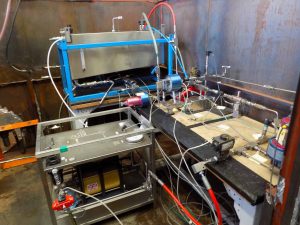
The components withstood up to 300,000 intensification cycles, continuously operating at a 345-bar low-pressure supply and a 520-bar high-pressure outlet, with pressure tightly controlled so it never exceeded the target level and varied by no more than 10% below it.
The programme used pure MEG mixed with 10% water without any anti-corrosion or lubricity additives, this was to simulate a worst-case fluid impact on the components subject to wear within the intensifier.
The controlled test programme incorporated the capability to certify accumulator pre-charge pressures, verify pressure switch functionality, and utilise fully calibrated and traceable instrumentation throughout the testing process. This ensured that all measurements and operating conditions were accurately monitored and aligned with the required performance parameters.
During the continuous endurance testing, the cycle count was monitored to record leak rates at design pressure, verify pressure delay performance and maintain temperature control within the specified limits. This provided consistent performance data while replicating the operational conditions expected in service.
Following completion of the testing programme, a comprehensive engineering analysis was carried out by Rotork. This included a full strip-down inspection of the components, seal integrity assessments, wear pattern documentation, and dimensional and surface condition reporting. The analysis was supported by photographic evidence and detailed technical reporting to provide a complete record of component performance and condition following testing.
“Our bespoke endurance testing helps customers replicate demanding operating conditions, reducing the risk of in-service failure and providing greater confidence in the long-term performance and reliability of their equipment.”
Result
This testing enabled the identification of potential degradation trends prior to field deployment and validated sealing resilience under contaminated fluid exposure.
Testing was conducted against endurance requirements aligned with API 17F. The programme enabled Tyne Pressure Testing to quantify leak rate progression, define performance capability up to 300,000 cycles, and provide data to support lifecycle assessments.
The results enhance customer confidence in subsea applications while strengthening overall product reliability and performance assurance.